

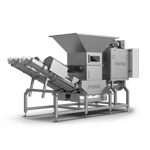
C.200 – Drainage press for grinding sludge & fine plastic particles
- Available in a painted finish or stainless steel
- Compact pressed blocks with a diameter of 200 mm
- For metal and plastic
- Automatic or manual mode
- Easy to clean and maintain
- No blockages
The WEIMA C.200 dewatering press is a high-performance hydraulic press designed for the efficient drying and volume reduction of grinding sludge and wet plastic waste. In metalworking, it compresses grinding sludge to compact discs with a diameter of 200 mm – entirely without a fault-prone screw conveyor. Coolants, emulsions and oils are reliably extracted and returned to the production cycle. The result is low-drip briquettes, reduced storage and disposal costs, and the sustainable recovery of recyclable materials.
In plastics recycling, the C.200 ensures cost-effective process optimisation: wet fine fractions and rejects from shredding and washing processes are effectively dewatered, significantly reducing the weight of the waste. The press separates liquid content from the material stream in a single efficient step, producing highly dewatered, transportable bales. This significantly reduces disposal costs and provides an environmentally friendly, cost-effective solution for recycling companies.
Technical details and application examples are presented further down this page.

On the conical discharge pipe, two movable half-shells – closed either by disc springs or hydraulically – provide the necessary back pressure. This compresses the chips into compact discs with a diameter of 200 mm.

To ensure simple and straightforward integration into existing machining systems, the feed height of the compact WEIMA chip compactor can be flexibly adjusted to suit the specific conditions using adjustable machine feet.

The dewatering press operates using a powerful hydraulic ram and, thanks to its generously sized pressing chamber, requires no screw conveyor, separate pre-compaction stage or additional moving parts. This reliably prevents material jams and bridging. Even contaminants and long, tangled chips can be pressed without any problems.

Chips are fed into the pressing chamber via a chip conveyor through a large hopper. There, they are compressed and dewatered by a horizontally movable press cylinder and ram. The extracted liquid is collected and filtered in a sump beneath the pressing channel. This allows the emulsion and cooling lubricants to be returned directly to the machining centre.

Integrated level sensors in the feed hopper enable fully automatic operation of the dewatering press. As soon as a defined fill level is reached, the machine starts automatically. If the fill level falls below the minimum, it automatically switches to standby mode to prevent unnecessary wear and tear on the components.

The C.200 Duo features two independent press pistons, which are fed alternately via a movable divider plate in the hopper. This allows both press chambers to be filled in turn, significantly reducing downtime. In the event of a fault, the system automatically switches to the available press channel, thereby ensuring continuous operation.

To make commissioning particularly straightforward, the C-Series presses are delivered pre-configured and ready for use as a plug-and-play solution. All that is required for installation is a power connection and a link to the upstream processing machine. On request, training on the machine’s functions and operation can also be provided digitally.

The colour display on the integrated Siemens PLC allows numerous parameters, such as pressing cycles, to be adjusted quickly and easily. The machine is connected to the machining centre via a simple signalling system – pressing only takes place when the chip conveyor is active. To minimise downtime, the system displays detailed diagnostic messages in the event of a fault, enabling rapid troubleshooting.

-
Output diameter (mm)
-
Throughput rate
-
Performance
-
Residual moisture
- 200
- up to 2 m³/h
- 4 kW | 400 V | 50 Hz
- 3 %


